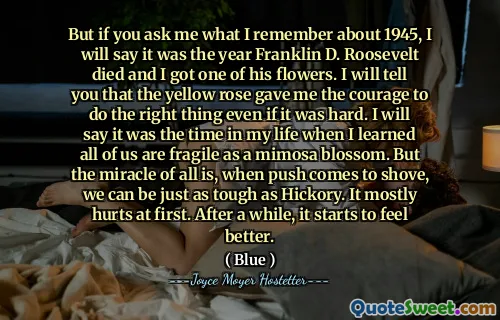
But if you ask me what I remember about 1945, I will say it was the year Franklin D. Roosevelt died and I got one of his flowers. I will tell you that the yellow rose gave me the courage to do the right thing even if it was hard. I will say it was the time in my life when I learned all of us are fragile as a mimosa blossom. But the miracle of all is, when push comes to shove, we can be just as tough as Hickory. It mostly hurts at first. After a while, it starts to feel better.
[Markdown format] The quote offers a poignant reflection on resilience and the transformative power of moments of tenderness and remembrance. The imagery of receiving Franklin D. Roosevelt's flower symbolizes a touchstone of hope and inspiration during a pivotal historical year, 1945, marking the end of World War II. The yellow rose, often a symbol of friendship and new beginnings, acts as a catalyst for courage, emphasizing how small acts of kindness or remembrance can bolster us to face difficult choices. The comparison of human fragility to a mimosa blossom poignantly captures life's delicacy, reminding us that vulnerability is universal. Yet, the resilience showcased here — the ability to be 'tough as Hickory' when necessary — celebrates the strength that comes from perseverance despite pain. The acknowledgment that hurt is part of growth, but that feelings can heal over time, resonates deeply. It underscores the importance of embracing our vulnerabilities, trusting in our inner strength, and recognizing that adversity, while painful initially, also offers opportunities for growth and renewal. This quote beautifully encapsulates the complex balance between fragility and strength, highlighting that hope and resilience are intertwined essentials for navigating life's unpredictable journey. It encourages us not to shy away from pain but to see it as a stepping stone toward greater fortitude and clarity.
( Blue ) - author: '---Joyce Moyer Hostetter---'