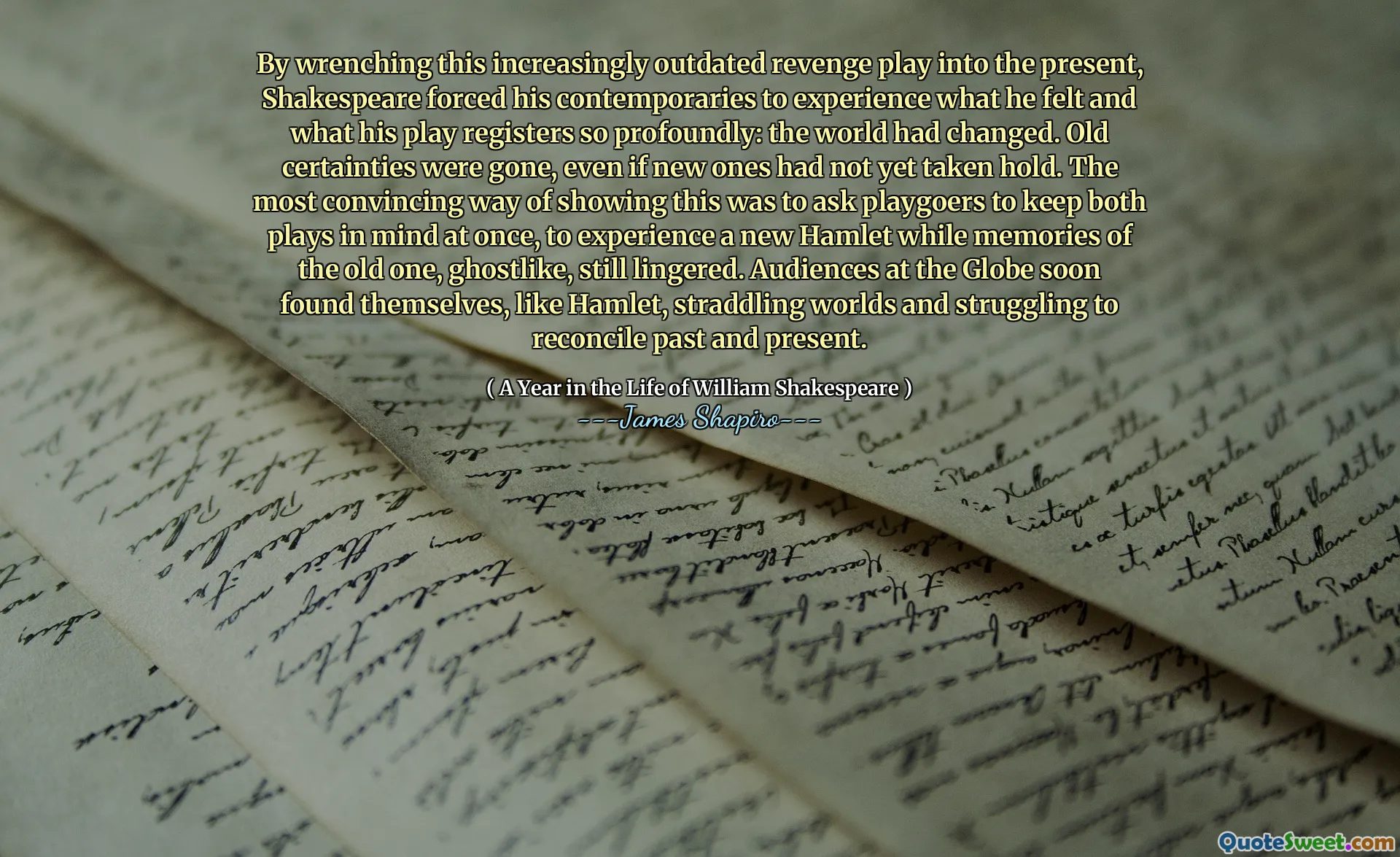
By wrenching this increasingly outdated revenge play into the present, Shakespeare forced his contemporaries to experience what he felt and what his play registers so profoundly: the world had changed. Old certainties were gone, even if new ones had not yet taken hold. The most convincing way of showing this was to ask playgoers to keep both plays in mind at once, to experience a new Hamlet while memories of the old one, ghostlike, still lingered. Audiences at the Globe soon found themselves, like Hamlet, straddling worlds and struggling to reconcile past and present.
Shakespeare revitalized the traditional revenge play form by setting it against the backdrop of his contemporary society, urging audiences to confront the shifts in their world. He highlighted the loss of old certainties, illustrating that while the past was fading, the future had yet to establish new foundations. This duality is crucial for understanding Hamlet, as it pushes viewers to engage with the evolving context of the play.
By compelling audiences to hold both the new and old interpretations of Hamlet in their minds, Shakespeare created a dynamic experience. The Globe's viewers were invited to navigate the tension between the familiar past and the uncertain present, mirroring Hamlet's own struggle. In doing so, Shakespeare deepened the emotional impact of the play, ensuring its relevance to the changing times.