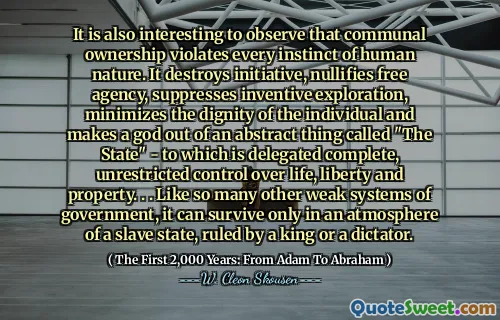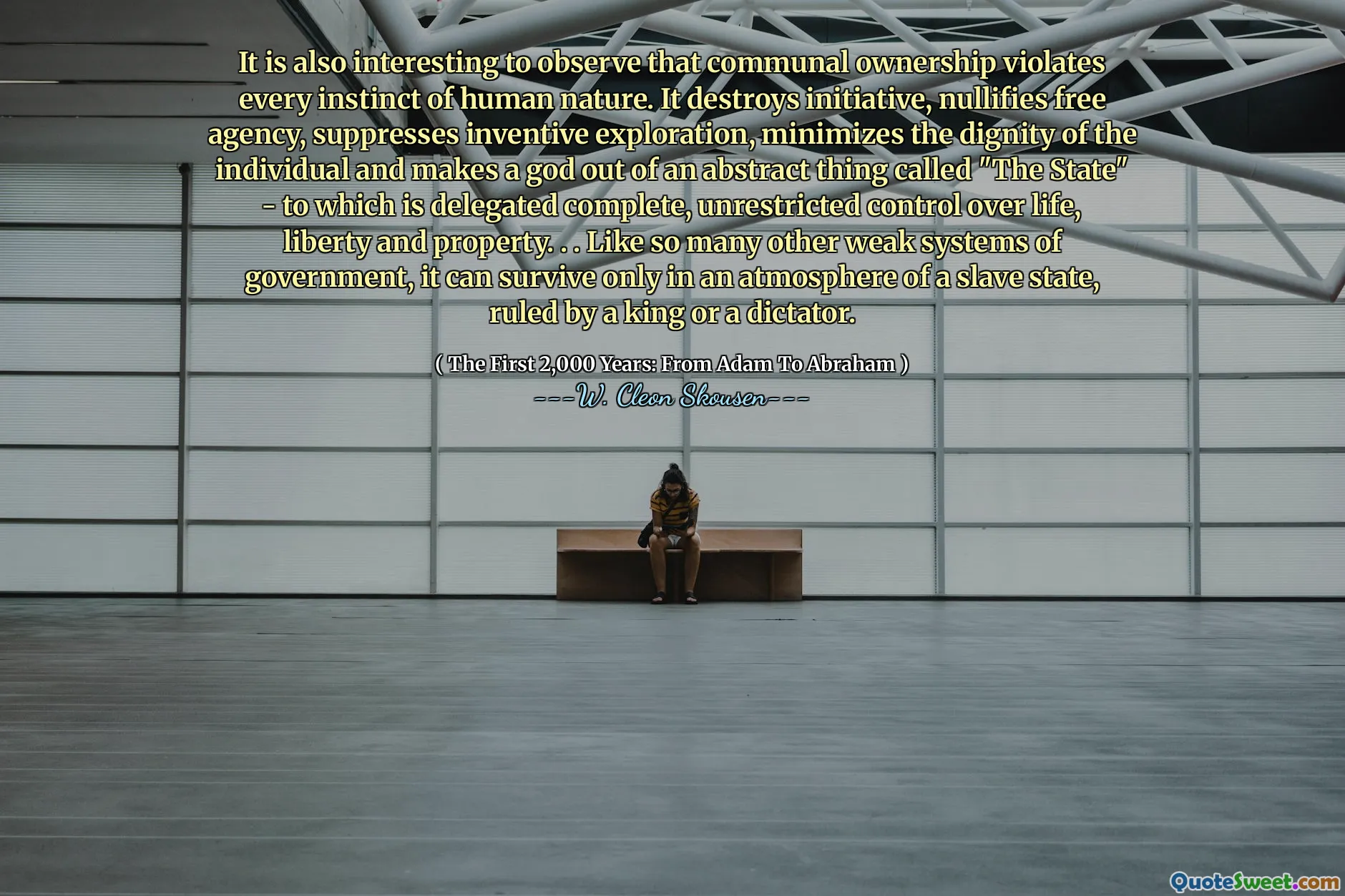
It is also interesting to observe that communal ownership violates every instinct of human nature. It destroys initiative, nullifies free agency, suppresses inventive exploration, minimizes the dignity of the individual and makes a god out of an abstract thing called "The State" - to which is delegated complete, unrestricted control over life, liberty and property. . . Like so many other weak systems of government, it can survive only in an atmosphere of a slave state, ruled by a king or a dictator.
This quote offers a compelling critique of communal ownership and its impact on human nature and individual freedom. It highlights the fundamental tension between collective systems and personal initiative, suggesting that when property and power are centralized in the state, it diminishes human independence, creativity, and dignity. The assertion that such systems make a 'god out of an abstract thing called "The State"' underscores the danger of idolizing government authority at the expense of individual rights. Historically, many regimes that implemented extensive state control often did so under the guise of equality or progress, but in reality, they curtailed freedoms and fostered dependence. The comparison to a 'slave state,' ruled by a king or dictator, emphasizes the loss of autonomous agency and the risk of tyranny. Human motivation often thrives on ownership, self-determination, and the ability to innovate; stripping these away can lead to stagnation and oppression. While some may argue that communal systems aim for equality or collective well-being, this quote underscores the potential dangers such systems pose when they suppress personal liberty and initiative. It serves as a reminder to balance collective efforts with respect for individual rights to prevent the rise of authoritarianism. This critique encourages vigilance against the allure of power centralized in the state, advocating for systems that recognize and protect human nature’s intrinsic desire for freedom and personal responsibility.