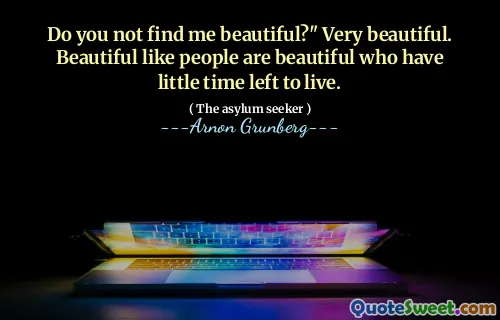
Do you not find me beautiful?" Very beautiful. Beautiful like people are beautiful who have little time left to live.
This quote delves into the profound reflection on beauty and mortality. It reveals a perspective that recognizes true beauty in the acceptance of life's finite nature. The speaker seems to suggest that beauty is not just an external or superficial attribute but something deeper that emerges when one confronts the transient aspect of existence. In acknowledging the fleetingness of life, individuals might shed superficial concerns and reveal their authentic selves, which can be genuinely beautiful.
The idea that beauty intensifies or becomes more genuine as life nears its end is both poignant and thought-provoking. It challenges societal standards that often equate beauty with youth or external features. Here, beauty is linked with the acceptance and understanding of mortality—an internal transformation that grants a different kind of luminosity to a person. It's a reminder that life's impermanence can awaken a new appreciation for the present moment and self-acceptance.
In the context of the book '(The asylum seeker)' by Arnon Grunberg, this quote could be seen as an exploration of human dignity amid circumstances of suffering and uncertainty. It underscores the universality of mortality and the idea that true beauty may lie in the acknowledgment of life's brevity.
This perspective invites us to reconsider our notions of beauty and to value qualities that come to the surface in the face of mortality — authenticity, vulnerability, and wisdom. It encourages us to look beyond superficial appearances and to find beauty in the acceptance of our natural cycles, embracing our fears, hopes, and mortality as essential parts of the human experience.