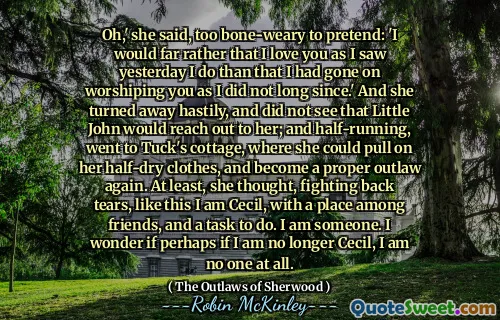
„Oh“, sagte sie, zu erschöpft, um so zu tun, „mir wäre es viel lieber, wenn ich dich so liebe, wie ich gestern gesehen habe, als dass ich dich weiter verehrt hätte, wie ich es noch nicht lange getan habe.“ And she turned away hastily, and did not see that Little John would reach out to her; and half-running, went to Tuck's cottage, where she could pull on her half-dry clothes, and become a proper outlaw again. At least, she thought, fighting back tears, like this I am Cecil, with a place among friends, and a task to do. Ich bin jemand. I wonder if perhaps if I am no longer Cecil, I am no one at all.
(Oh,' she said, too bone-weary to pretend: 'I would far rather that I love you as I saw yesterday I do than that I had gone on worshiping you as I did not long since.' And she turned away hastily, and did not see that Little John would reach out to her; and half-running, went to Tuck's cottage, where she could pull on her half-dry clothes, and become a proper outlaw again. At least, she thought, fighting back tears, like this I am Cecil, with a place among friends, and a task to do. I am someone. I wonder if perhaps if I am no longer Cecil, I am no one at all.)
In dieser Passage drückt die Figur ein tiefes Gefühl der Erschöpfung und des emotionalen Aufruhrs aus. Sie erkennt den Wandel in ihren Gefühlen und zieht die Ehrlichkeit ihrer aktuellen Liebe einer früheren Idealisierung vor. Diese Erkenntnis führt dazu, dass sie sich hastig zurückzieht und die vor ihr liegende Verbindung hinter sich lässt, was auf einen Kampf zwischen Verletzlichkeit und Selbstwertgefühl hindeutet.
Während sie zu Tucks Cottage eilt, sucht sie als Gesetzlose den Trost der Zugehörigkeit und Identität unter ihren Mitmenschen. Trotz ihres Kummers findet sie Trost in ihrer Rolle als Cecil, die ihr einen Sinn gibt. Die Reflexion über ihre Identität wirft existenzielle Bedenken auf und fragt sich, ob sie sich ohne ihre Rolle überhaupt wie niemand fühlen würde.